Latest Movie :
Recent Movies
Showing posts with label Solar. Show all posts

A flat panel solar cell


A flat panel solar cell

I made a more portable version of the solar cell in a flat panel form. I used the clear plastic top from a plastic CD jewel case as the window, and lots of silicone rubber glue to both attach the pieces together and to insulate them from each other.
homemade solar cell
The first step is to make a cuprous oxide plate like we did in the first solar cell. This time I sanded one corner clean all the way down to the shiny copper, and soldered an insulated copper wire to it for the negative lead.
soldered solar cell
The positive plate is a U shaped piece cut from the copper sheeting, a little bit larger than the cuprous oxide plate, with the cutout portion of the U a little bit smaller than the cuprous oxide plate. Another insulated copper wire is soldered to one corner of the U.
The first step in construction is to glue the U shaped copper plate to the plastic window. Use plenty of silicone glue, so the saltwater won't leak out. Make sure that the solder connection is either completely covered with glue, or is outside of the glue U, as shown in the photo (completely covered in glue is best).
The photo below shows the back side of the solar cell (the side not facing the sun) at this point in the construction.
flat panel solar cell
The photo below shows the front side of the solar cell (the side that will face the sun) at this point in the construction. Notice that the silicone glue does not completely cover the copper, since some of the copper must eventually be in contact with the saltwater.
solar cell homemade
The next step is to lay a good size bead of glue onto the U shaped clean copper plate. This layer will act as an insulator between the clean copper plate and the cuprous oxide plate, and must be thick enough to leave some room for the saltwater. Again, not all of the copper is covered, so there will be plenty of copper in contact with the saltwater.
Gently press the cuprous oxide plate onto this layer of glue. You should press hard enough to make sure the glue seals off any gaps, but not so hard that the two plates touch.
The photo below shows the back side of the solar cell (the side not facing the sun) at this point in the construction.
build a solar cell
The photo below shows the front side of the solar cell (the side that will face the sun) at this point in the construction. Note that I added extra glue to form a funnel at the top to allow the saltwater to be added.
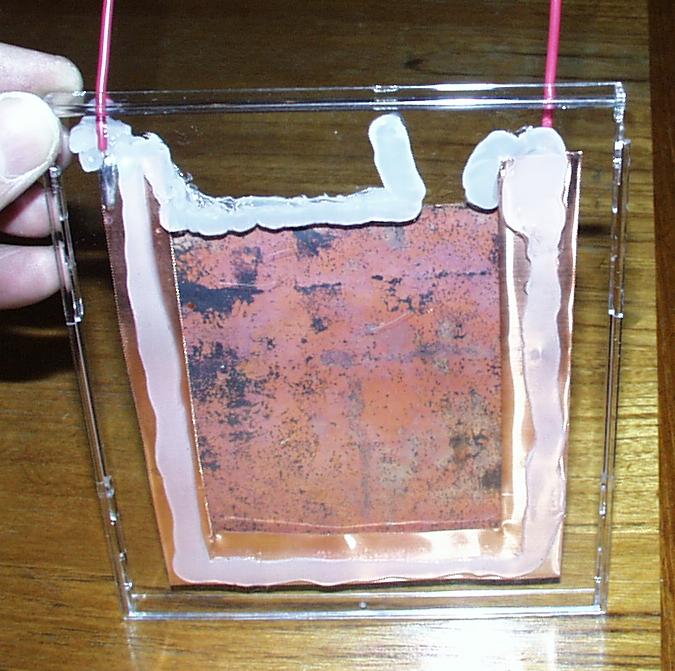
Flat panel solar cell
You can click on the photo above to get a bigger picture.
Not shown in the photo is a generous extra bead of glue all around the outside of the plates, to ensure that no saltwater will leak out. Allow the glue to cure before going on to the next step.
Next, use a large eyedropper to add the saltwater. Fill the cell up almost to the top of the copper plate, so it almost spills out. Then seal the funnel with another generous bead of glue, and allow the glue to cure at least a half hour.
solar cell with meter
In the photo above you can see the flat panel solar cell in action in the bright sun. It is delivering about 36 microamperes of current. You can also see the extra bead of glue around the edges of the plates, and filling the top of the funnel.
solar cell in the dark
Finally, another shot of the author's shadow. Note that the meter now reads about 4 microamperes, since no sunlight is falling on it.

A note about power

Many readers were jumping straight to this page without reading the previous project, so I am repeating this note here:
The cell produces at most about 50 microamps at 0.25 volts. 
This is 0.0000125 watts (12.5 microwatts). 
Don't expect to light light bulbs or charge batteries with this device. It can be used as a light detector or light meter, but it would take acres of them to power your house.

The 0.0000125 watts (12.5 microwatts) is for a 0.01 square meter cell, or 1.25 milliwatts per square meter. To light a 100 watt light bulb, it would take 80,000 square meters of cuprous oxide for the sunlit side, and 80,000 square meters of copper for the dark electrode. To run a 1,000 watt stove, you would need 800,000 square meters of cuprous oxide, and another 800,000 square meters of plain copper, or 1,600,000 square meters all together. If this were to form the roof of a home, each home would be 282 meters long and 282 meters wide, assuming all they needed electricity for was one stove.
There are 17,222,256.7 square feet in 1,600,000 square meters. If copper sheeting costs $5 per square foot, the copper alone would cost $86,110,283.50 USD. Making it one tenth the thickness can bring this down to $8,611,028.35. Since you are buying in bulk, you might get it for half that, or about $4,300,000.00.
If you used silicon solar panels costing $4 per watt, you could run the same stove for $4,000.00. But the panels would only be about 10 square meters.
Or, for about a dollar, you can build a solar stove out of aluminum foil and cardboard. For about $20, you can build a very nice polished aluminum parabolic solar cooker.
{[['']]}

How to build the solar cell


How to build the solar cell

My burner looks like this:
The first step is to cut a piece of the copper sheeting that is about the size of the burner on the stove. Wash your hands so they don't have any grease or oil on them. Then wash the copper sheet with soap or cleanser to get any oil or grease off of it. Use the sandpaper or wire brush to thoroughly clean the copper sheeting, so that any sulphide or other light corrosion is removed.
Next, place the cleaned and dried copper sheet on the burner and turn the burner to its highest setting.
As the copper starts to heat up, you will see beautiful oxidation patterns begin to form. Oranges, purples, and reds will cover the copper.
As the copper gets hotter, the colors are replaced with a black coating of cupric oxide. This is not the oxide we want, but it will flake off later, showing the reds, oranges, pinks, and purples of the cuprous oxide layer underneath.
The last bits of color disappear as the burner starts to glow red.
When the burner is glowing red-hot, the sheet of copper will be coated with a black cupric oxide coat. Let it cook for a half an hour, so the black coating will be thick. This is important, since a thick coating will flake off nicely, while a thin coat will stay stuck to the copper.
After the half hour of cooking, turn off the burner. Leave the hot copper on the burner to cool slowly. If you cool it too quickly, the black oxide will stay stuck to the copper.
As the copper cools, it shrinks. The black cupric oxide also shrinks. But they shrink at different rates, which makes the black cupric oxide flake off.
The little black flakes pop off the copper with enough force to make them fly a few inches. This means a little more cleaning effort around the stove, but it is fun to watch.
When the copper has cooled to room temperature (this takes about 20 minutes), most of the black oxide will be gone. A light scrubbing with your hands under running water will remove most of the small bits. Resist the temptation to remove all of the black spots by hard scrubbing or by flexing the soft copper. This might damage the delicate red cuprous oxide layer we need to make to solar cell work.
The rest of the assembly is very simple and quick.
Cut another sheet of copper about the same size as the first one. Bend both pieces gently, so they will fit into the plastic bottle or jar without touching one another. The cuprous oxide coating that was facing up on the burner is usually the best side to face outwards in the jar, because it has the smoothest, cleanest surface.
Attach the two alligator clip leads, one to the new copper plate, and one to the cuprous oxide coated plate. Connect the lead from the clean copper plate to the positive terminal of the meter. Connect the lead from the cuprous oxide plate to the negative terminal of the meter.
Now mix a couple tablespoons of salt into some hot tap water. Stir the saltwater until all the salt is dissolved. Then carefully pour the saltwater into the jar, being careful not to get the clip leads wet. The saltwater should not completely cover the plates -- you should leave about an inch of plate above the water, so you can move the solar cell around without getting the clip leads wet.
The photo above shows the solar cell in my shadow as I took the picture. Notice that the meter is reading about 6 microamps of current.
The solar cell is a battery, even in the dark, and will usually show a few microamps of current.
The above photo shows the solar cell in the sunshine. Notice that the meter has jumped up to about 33 microamps of current. Sometimes it will go over 50 microamps, swinging the needle all the way over to the right.

How does it do that?

Cuprous oxide is a type of material called a semiconductor. A semiconductor is in between a conductor, where electricity can flow freely, and an insulator, where electrons are bound tightly to their atoms and do not flow freely.
In a semiconductor, there is a gap, called a bandgap between the electrons that are bound tightly to the atom, and the electrons that are farther from the atom, which can move freely and conduct electricity.
Electrons cannot stay inside the bandgap. An electron cannot gain just a little bit of energy and move away from the atom's nucleus into the bandgap. An electron must gain enough energy to move farther away from the nucleus, outside of the bandgap.
Similarly, an electron outside the bandgap cannot lose a little bit of energy and fall just a little bit closer to the nucleus. It must lose enough energy to fall past the bandgap into the area where electrons are allowed.
When sunlight hits the electrons in the cuprous oxide, some of the electrons gain enough energy from the sunlight to jump past the bandgap and become free to conduct electricity.
The free electrons move into the saltwater, then into the clean copper plate, into the wire, through the meter, and back to the cuprous oxide plate.
As the electrons move through the meter, they perform the work needed to move the needle. When a shadow falls on the solar cell, fewer electrons move through the meter, and the needle dips back down.

A note about power

The cell produces 50 microamps at 0.25 volts. 
This is 0.0000125 watts (12.5 microwatts). 
Don't expect to light light bulbs or charge batteries with this device. It can be used as a light detector or light meter, but it would take acres of them to power your house.

The 0.0000125 watts (12.5 microwatts) is for a 0.01 square meter cell, or 1.25 milliwatts per square meter. To light a 100 watt light bulb, it would take 80,000 square meters of cuprous oxide for the sunlit side, and 80,000 square meters of copper for the dark electrode. To run a 1,000 watt stove, you would need 800,000 square meters of cuprous oxide, and another 800,000 square meters of plain copper, or 1,600,000 square meters all together. If this were to form the roof of a home, each home would be 282 meters long and 282 meters wide, assuming all they needed electricity for was one stove.
There are 17,222,256.7 square feet in 1,600,000 square meters. If copper sheeting costs $5 per square foot, the copper alone would cost $86,110,283.50 USD. Making it one tenth the thickness can bring this down to $8,611,028.35. Since you are buying in bulk, you might get it for half that, or about $4,300,000.00.
If you used silicon solar panels costing $4 per watt, you could run the same stove for $4,000.00. But the panels would only be about 10 square meters.
Or, for about a dollar, you can build a solar stove out of aluminum foil and cardboard. For about $20, you can build a very nice polished aluminum parabolic solar cooker.
{[['']]}

alternative energy specialists


Fancy a free solar thermal system? well look no further. We at AES are full of the Christmas spirit and for a limited time only any one that buys a Solar PV system or a Biomass boiler from us will get a free solar thermal system installed.
This offer is for a limited time only so contact us today for a quote!
Here at AES we provide a wide range of Alternative Energy from Biomass Boilers, Solar PV, Solar Thermal to Ground Source and Airsource Heat Pumps.
AES are the leading suppliers of alternative solutions. We provide residential and commercial properties with cost effective alternative energy products.
We supply the latest innovative biomass boilers, solar thermal and PV systems. Biomass boilers are an environmentally sound, heating solution. Burning biomass, such as wood pellets or logs, emits a similar amount of carbon dioxide as is absorbed by plants and trees. Biomass is therefore, the only real carbon-neutral energy.
Solar water heating systems use heat from the sun to warm domestic hot water. A normal boiler or immersion heater can be used to make the water hotter and to provide hot water when solar energy is not available.
Solar electricity systems capture the sun’s energy using photovoltaic (PV) cells. The cells convert the sunlight into electricity, which can be used to run household appliances and lighting. PV cells don’t need direct sunlight to work – you can still generate some electricity on a cloudy day
Our ground and air source heat pumps use latent energy in the ground or outside air. This provides low cost heating and hot water to virtually any type of property.

“On the basis of our experience I am very happy to recommend AES (Alternative Energy Specialists) to prospective customers. AES installed our solar photovoltaic system extremely efficiently. This coupled with very efficient administration and pleasant staff made dealing with this company a pleasure. – Sir Christopher Edwards”
{[['']]}

New Jersey Solar Installers

New Jersey Solar Installers
20110711090713-b0f26c67Green Apple Energy is a fully licensed solar installer operating throughout the state of New Jersey. To be more specific, our home base is actually located out of Monmouth County.  Although we offer solar installation throughout NJ, most of our focuses are on residential and commercial clients throughout Monmouth and Ocean Counties, NJ.

New Jersey Solar Financial Incentives & Rebates


Click or Tap Here To View New Jersey Solar Incentives & Rebates

Residential Solar Installers in New Jersey

Are you ready to start saving money? There are many different names that mean “residential solar system.” You’ve probably heard of one or the other. These include grid-tie, residential solar, and home solar. At the end of the day, they all represent the same thing; A solar energy system that will provide you with clean, renewable energy from the sun.   The benefits when it comes to solar energy are enormous.
  • Green Apple Energy offers zero down financing on solar installations for your home in NJ
  • You can actually get a return on your investment vs. paying the utility with no return every month
  • This is a non-polluting energy source
  • It’s renewable (unlike fossil fuels which will eventually run out)
  • You can sell your excess power back to the utility
  • Very low maintenance
  • Solar panels can last well over 20 years
  • Once installation is complete-your power is free!
  • You can monitor your savings as well as usage via software

Commercial Solar Installers in New Jersey

Whether you own an office building or strip malls, going solar is a fantastic 20110719085726-3f5a26c6economic choice for commercial establishments.  A commercial solar system will provide fixed cost energy pricing for your business from a clean, renewable energy source. With all of the government and state sponsored incentives, there’s never been a better time to convert over to solar. For large commercial establishments, Green Apple Energy can supply your business with large solar panels that can be positioned on rooftops or structures adjacent to your building.  If your facility utilizes more power than the solar panels provide, you’ll always have the main grid as a backup. However, if your solar panels generate more power than your establishment needs, your utility will credit your energy bill for the excess energy.

Commercial Solar Power Benefits in New Jersey

  • You’ll typically see a return on your investment within 3-4 years
  • You can sell extra power back to the utility company
  • Reduce your electric bill from 50-90% (we’ve seen it hit $0!)
  • The federal government permits accelerated depreciation for solar energy technology
  • Reduce your electric bill from 50-90% (we’ve seen it hit $0!)
  • A commercial solar energy system is a long term capital investment (they last well over 25 years, the solar energy model works to reduce and flatten variable costs into a fixed model making this extremely cost effective for any business)
  • Give your business an environmentally friendly image to back it up

Our Five Step Installation Process in New Jersey

Step 1 – Analysis and Consultation: One of the first things our energy consultants will do is go over a thorough on-site energy usage analysis. We realize it’s very important that we take your goals into account
Step 2 – Proposal and Contract: By going through all available factors related to your solar installation such as budgetary concerns, available technology, equipment specifications, cost/benefit analysis and rebate incentives; we will develop a proposal custom tailored to your residential or commercial property.
Step 3 – Design and Permitting: Don’t worry about design or any of the legal hassles that might go along with proper installation. We are completely experienced when it comes to compliance with the National Electric Code as well as local New Jersey jurisdiction regulations. Our design teams are all NABCEP (North American Board of Certified Energy Practitioner) certified.  For solar panel equipment and materials, we only use the highest quality in brands and have relationships with manufacturers all over the world.
Step 4 – Solar Panel System Installation:  One of the most common questions we get is, “What separates you’re from the competition?  We always say it’s “our love for installing solar energy systems.”  So when it comes to your home or business, we truly take pride in our workmanship.  Our NJ solar installers will arrive on time daily, leave in the evening and will always make sure everything is maintained in a clean, professional manner.
Step 5 – Cost Savings & Maintenance: This is the best part of Green Apple Energy’s five step process! You can now begin saving money and producing environmentally friendly renewable energy. Our photovoltaic systems are extremely reliable, durable and easy to maintain. By cleaning your panels twice a year, your solar energy system will be running at peak performance.

New Jersey Solar Service Areas

We provide complete residential and commercial solar installations throughout Atlantic County, Bergen County, Burlington County, Camden County, Cape May County, Cumberland County, Essex County, Gloucester County, Hudson County, Hunterdon County, Mercer County, Middlesex County, Monmouth County, Morris County, Ocean County, Passaic County, Salem County, Somerset County, Sussex County, Union County, and Warren County
{[['']]}

Residential Solar Service


Residential Solar Service

Zero down solar familySolar is the cleanest and most sustainable form of energy on Earth, producing no emissions and requiring little or no maintenance. It is also an excellent financial investment.
An expertly installed solar system can generate all of the electricity needed to power your home. Green Apple Energy systems add value to your home while protecting you from rising energy costs. Solar simultaneously allows you to control your electric bill and your impact on the environment.
We are  providing a true turnkey solar experience utilizing in-house experts to design the best system to fit your energy  needs. We use only the best of brand products to deliver custom PV solutions that optimize return on investment and aesthetic appeal.

Residential Solar Installations

Green Apple Energy is a leader in the design and installation of residentialSolar Installer NJ photovoltaic power systems. We are a turnkey solar integrator delivering a wide range of services from initial homeowner consultation through final construction completion and beyond.
Our integrity, dedication to client satisfaction, and experienced teams set us apart from our competitors. When working with Green Apple Energy you can be sure that we deliver what we promise,on time and on budget.

Analysis and consultation

Our knowledgeable Energy Consultants conduct a detailed energy usage analysis and a free site evaluation of your home in order to determine which systems are optimal. Our solar experts will listen to your specific objectives and help you understand your choices and the technologies available. Our objective is to help you realize your goals, by working together to ensure your aesthetic and budgetary concerns are addressed, while delivering production performance and reliability.

Residential Solar Design and Permitting

Our team of North American Board of Certified Energy Practitioner (NABCEP) designers will design a system that complies with the National Electric Code and abides by local jurisdiction regulations. You will have the final approval of the solar system design prior to our submittal for permitting. Green Apple Energy has direct relationships with top solar product manufacturers worldwide and only premium products will be used in the construction of your solar system. Green Apple Energy delivers technical expertise and attention to detail. As a premier professional solar contractor, we take care of every last project detail to optimize the performance and aesthetics of your solar system.

Solar Installation and interconnection

Green Apple Energy takes great pride in every system we build. Installation dates are coordinated with the client and project timelines are clearly communicated. Our professional crews arrive each day on time, conduct their work in a respectful and courteous manner, and leave work sites clean every evening. Residential systems are generally completed within 3-5 days depending on size and complexity.

Post Installation Customer Service

Green Apple Energy Customer Service and Warranty Team guides each client through the transition from construction to full system operation and provides long-term maintenance and service for years to come.

SREC Management

We  offer Solar Renewable Energy Certificate (SREC) Management, ensuring our customers take full advantage of current pricing and not missing out on their yearly payout.

Comprehensive Warranties

We offers full service warranties for up to 5 years in addition to manufacturer’s equipment warranties that cover equipment for 25 years. We guarantee that your system will have exceptional performance over its lifetime and with high quality equipment that’s built to last.
{[['']]}

Benefits of Solar Installation


Benefits of Solar Installation

The sun is 93 million miles away, but you can harness its power right at home…

Solar is a Local Sustainable Energy Solution

By going solar, you generate your home’s power directly where you use it.
The clean and renewable electricity you are producing doesn’t just benefit your household, it benefits the community. By converting to solar, you reduce the demand for coal and other fossil fuels that would otherwise need to be extracted from the earth and transported long-distances to huge power stations.
Electricity transmission and distribution losses in the US are estimated at over 7%. There is no more effective, efficient, and sustainable way to supply energy to your home than with a residential solar system.

Going Solar Reduces Pollutants and Greenhouse Gas Emissions

Electricity generated by solar systems offsets the amount of greenhouse gases that would otherwise be emitted by non-renewable fuels such as coal, natural gas and petroleum. Solar is the only renewable energy source that does not consume or pollute water. Solar is also silent – reducing noise pollution.

Going Solar Conserves Energy

The demand for energy is increasing at an alarming rate. Consider that for every British thermal unit (BTU) of coal or natural gas burned in a combustion turbine only 35 percent is typically converted into useful power (electricity). The other 65 percent is heat loss discharged into the environment.
By using alternative energy sources such as solar, which generate energy at the site of consumption, we can conserve fossil fuels and other natural resources that are non-renewable. When you consider that the sun’s energy is both limitless and worldwide, it only makes sense to harness it for the health and well-being of future generations
{[['']]}

Election 2012 Romney on Energy

 Election 2012: Romney on Energy
After last week's review of President Obama's energy record and campaign materials on energy, Governor Romney's energy plans present a sharp contrast. They are based on a fundamentally different view of energy and the economy, relying on markets to allocate capital to the most productive opportunities, rather than on government to guide a mix of public and private investments along specific paths towards designated ends. They also emphasize technologies that are already deployed at scale today, not those still under development or striving to attain scale. Implicitly, the Romney plan prioritizes supplying the energy for a robust economic recovery over programs designed to address long-term environmental challenges like climate change. These positions present voters with a serious and consequential choice on November 6th.
The Romney campaign's website on energy arrays the candidate's ideas mainly in words, rather than with the kind of images and interactive features that dominate the Obama campaign's sites. Energy is the first plank of Governor Romney's five-point "Plan for a Stronger Middle Class", though it requires a little work to explore the details of his energy program. A list of bullet points  is backed up by a lengthy policy paper with numerous references to external sources, but you have to look for it. 
The Romney energy plan focuses mainly on oil, gas, coal and nuclear energy, which together meet 91% of current US primary energy demand and which the Department of Energy projects will still provide nearly 90% in 2020 under the policies in place today. You won't find much on his campaign's website about the new renewables that generated electricity equivalent to 2% of our energy use last year, beyond a critique of the administration's investment in Solyndra and a commitment to R&D on new energy technologies.

Among the details of his plan are support for expanded offshore drilling, including areas such as offshore Virginia that were originally in the Obama administration's early-2010offshore development blueprint, along with a comprehensive assessment of US resources using current technology, rather than further extrapolations based on 1980s technology. Governor Romney proposes expanding energy cooperation with both Canada and Mexico and would approve the entire Keystone XL pipeline. His goal of attaining North American energy independence is aggressive, yet recent analysis by Citigroup puts it within the realm of possibility. It appears to be based on an assessmentby Wood Mackenzie, a top-notch energy consultancy, indicating that US oil and natural gas liquids output could expand by 7.6 million barrels per day, with 6.7 million of that coming from federal lands and waters currently off-limits to development. That compares to US net petroleum imports of 8.5 million barrels per day in 2011.

Another aspect of the plan aimed at streamlining the permitting of energy projects could be just as useful for utility-scale renewable energy projects as for oil and gas exploration and production. Regulatory and permitting delays are among the key reasons it takes longer and costs more to develop crucial energy and infrastructure projects here than in many of the countries against which our competitive standing has been slipping. Governor Romney also proposes giving states greater control of permitting on their non-park federal lands. That could substantially increase energy access and output, especially in the west, where the federal government owns over 280 hundred million acres, or 37% of those 11 states, net of tribal lands. 

There are also some missing elements. I would have liked to see more about how renewables fit into Governor Romney's vision. He apparently supports the Renewable Fuels Standard but is silent about the increasingly urgent need to reform it. He is on record against the extension of the wind Production Tax Credit (PTC), a 20-year old subsidy roughly equivalent to the current price of natural gas, yet misses the opportunity to explain how all types of energy would be treated under his proposal to reduce corporate income tax rates while broadening the tax base--policy-speak for closing loopholes and eliminating incentives. In last night's debate he said, referring to the $2.8 billion in annual tax incentives for oil and gas identified by the Department of Energy, "... if we get that tax rate from 35 percent down to 25 percent, why that $2.8 billion is on the table. Of course it's on the table. That's probably not going to survive (if) you get that rate down to 25 percent." I'd also like to hear more about how Governor Romney would address greenhouse gas emissions once the economy returns to stronger growth. 

Superficially, much of the Romney energy agenda evokes a return to the pre-2008 status quo: heavy on oil, gas and coal, light on renewables, and largely ignoring climate change. I see it from a different perspective: When Barack Obama began running for President in 2007, the US was considered by many to be tapped out on conventional energy, with domestic oil and natural gas production exhibiting signs of deep and permanent decline. In that context it made sense to look beyond those resources to the potential of renewable energy and vehicle electrification, even if the transition involved would be lengthy. That approach also appeared synergistic with reducing greenhouse gas emissions, and a strategy was born. In the meantime, however, it turned out that US oil and gas were far from exhausted, and the most productive new energy technology of this decade wasn't wind, solar or biofuels, but the combination of hydraulic fracturing ("fracking") and horizontal drilling that has unlocked hundreds of trillions of cubic feet of shale gas and tens of billions of barrels of shale oil or "tight oil" resources. Since 2008 the expansion of shale gas drilling has added as much new US energy production as over 250,000 MW of wind turbines or solar panels--8x the wind andsolar power added in the same interval. To the surprise of many, the big global energy opportunity of the 20-teens is US hydrocarbons. The Romney plan reflects the unexpected energy transformation we're experiencing. 

As in 2008, this blog isn't in the business of endorsing candidates. Energy remains an issue that, like the Cold War, demands bi-partisan cooperation and some level of consistency from one administration or Congress to the next. However, that doesn't prevent me from observing that the energy agendas of the two campaigns are not equally well-suited for a period of serious US fiscal constraints and shrinking federal discretionary expenditures, in which our energy security and economic growth will still depend largely on fossil fuels. In that context, it's highly relevant that the "all of the above" credentials of one candidate depend on oil and gas outcomes that his policiesdid little to support. Of course, energy isn't the only issue that matters, but then you wouldn't be reading this if you didn't think it was important.
{[['']]}
poower
 
Support : Creating Website | mayank | Mas Template
Copyright © 2009. Auditor Link - All Rights Reserved
Template Created by Creating Website Published by salman
Proudly powered by videos